Practical guidance for storing, handling, and integrating Endo-1,4-β-Mannanase in industrial processes, from warehouse control to dosing-point selection.
Request pricingEndo-1,4-β-Mannanase is used where mannan-rich fibers create viscosity, poor flow, inconsistent extraction, or reduced nutrient availability. The enzyme can be highly useful in feed, food processing, biomass conversion, detergent systems, and other industrial applications — but the result depends on more than choosing the right chemistry.
Buying for a plant or for resale? We supply mannanase in bulk to manufacturers and resellers on a quote basis and tell you the storage conditions for the grade you choose; send the application, quantity and destination. Request a quote.
Storage discipline, transfer control, and addition-point design all influence whether mannanase performs predictably at production scale.
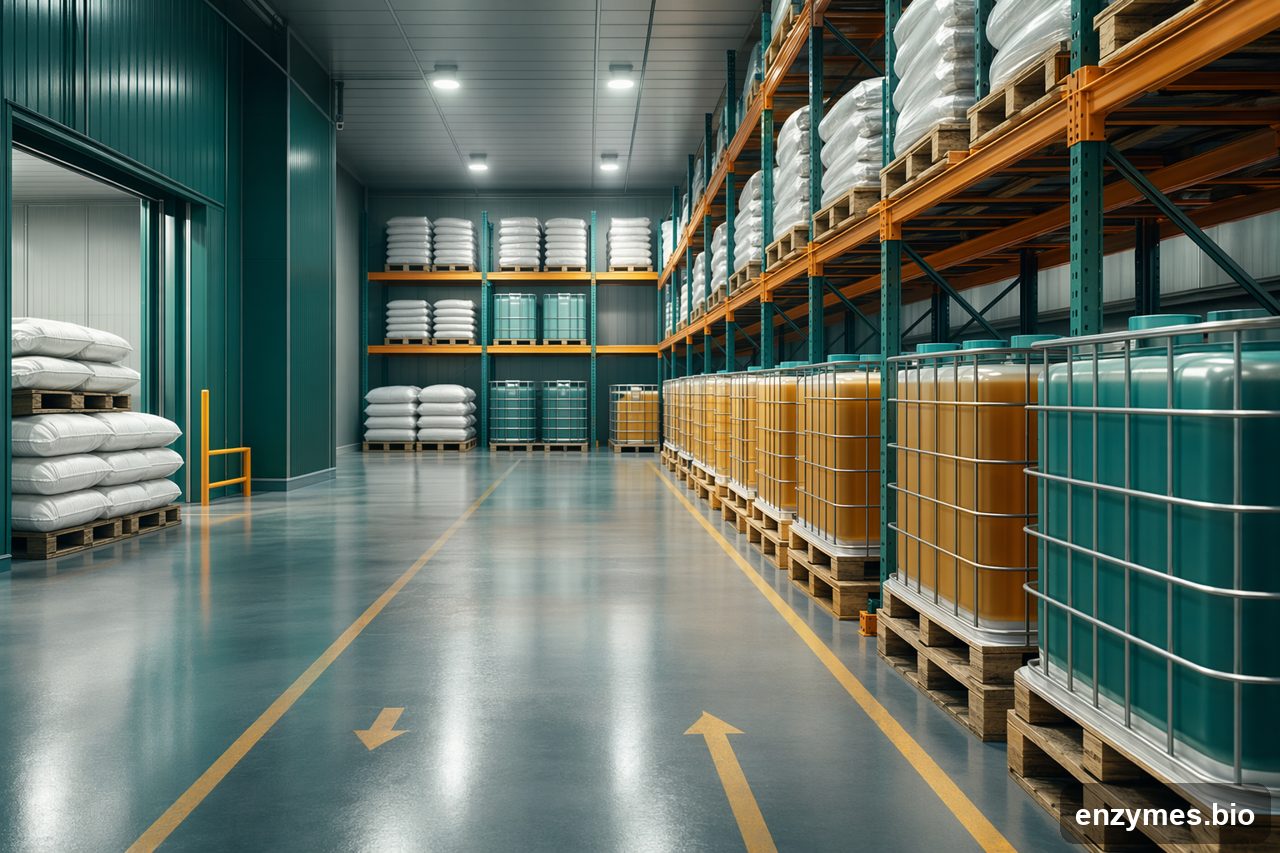
This guide covers the operational basics technical buyers, process engineers, and production teams should confirm before plant trials or routine supply.
Mannanase works by cleaving internal bonds in β-mannan structures. In practical terms, that can help reduce viscosity, open fiber networks, improve flow, support extract release, and improve access to trapped material.
For dependable performance, the enzyme needs four process conditions to line up:
The most common integration mistake is treating mannanase as a simple additive. It is a processing tool. Placement, timing, and local conditions matter.
Mannanase is commonly supplied as either a dry preparation or a liquid formulation. Exact requirements depend on the product format and formulation system, so the product specification and safety data sheet should be the controlling documents.
Use storage practices that protect the enzyme from moisture, heat, and contamination:
Moisture is a key risk for dry enzyme preparations. It can affect handling behavior, increase clumping, and reduce predictability during dosing.
Liquid mannanase products should be protected from temperature abuse and contamination:
For liquid systems, microbial control, formulation integrity, and clean transfer practice are as important as temperature control.
Enzymes are industrial processing aids, but they still require controlled handling. Powder dust and liquid aerosols should be treated as occupational exposure risks.
Recommended handling controls include:
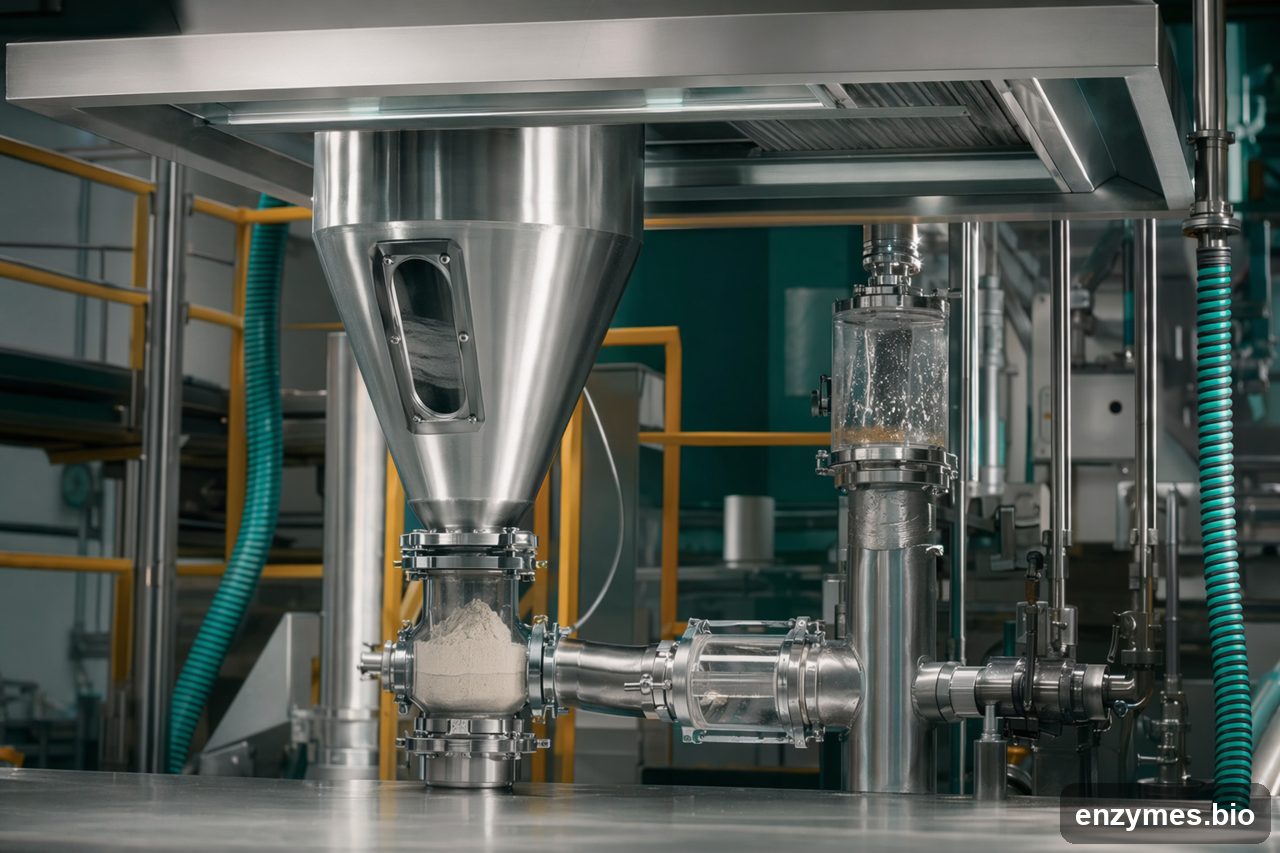
A good handling system protects personnel and protects batch consistency. Less dust, mist, and open handling also means less product loss and cleaner dosing.
The best addition point is not always the nearest injection port. It is the point where substrate contact, process temperature, pH, and residence time align.
When selecting the dosing location, confirm:
In many systems, performance improves when mannanase is added after harsh front-end steps and before the point where viscosity, extraction, filtration, or digestibility becomes limiting.
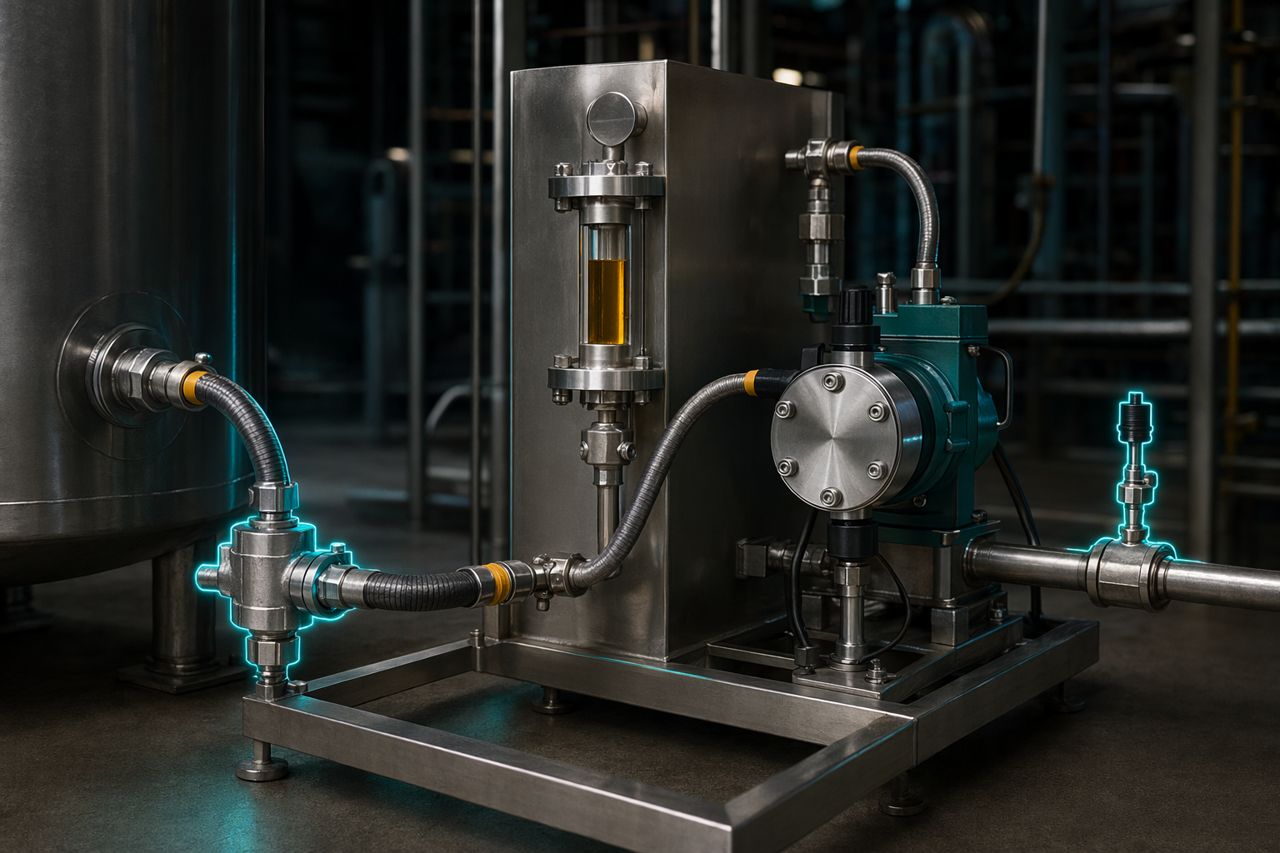
Mannanase should be introduced in a way that supports rapid dispersion and controlled contact.
Practical design considerations:
For powders, pre-blending may be appropriate when the process requires uniform distribution through a dry mix. For liquids, metered injection is often preferred where continuous flow control is needed.
Before scaling up, confirm compatibility with the real process matrix rather than only the theoretical recipe.
Review these variables:
A short technical review can prevent a plant trial from being judged on a poor addition point rather than on the enzyme itself.
For feed systems, mannanase may be used to support performance where β-mannans contribute to anti-nutritional effects or viscosity-related limitations. Integration should account for premix uniformity, conditioning exposure, pelleting conditions, and post-process handling.

If the enzyme must survive thermal processing, confirm that the selected format and addition strategy match the manufacturing route. If heat exposure is not suitable, consider where post-processing application is feasible.
In food and ingredient operations, mannanase can support viscosity reduction, extraction, clarification, or texture-related processing goals. The key is to add the enzyme when the substrate is hydrated and accessible, while avoiding immediate inactivation by heat or extreme pH.
Regulatory status, allergen controls, labeling requirements, and plant-specific quality systems should be reviewed before commercial use.
In biomass streams, mannanase may help open hemicellulose-rich structures and improve flow or downstream conversion. Integration should be coordinated with pretreatment chemistry, solids loading, mixing energy, and separation steps.
High-solids systems need particular attention to contact quality. If the enzyme cannot reach the substrate, increasing dose will not solve the real bottleneck.
In detergent systems, mannanase compatibility must be checked against surfactants, builders, oxidizing components, preservatives, and storage conditions. The enzyme format should match the formulation architecture and expected shelf-life conditions.
Do not assume compatibility with concentrated formulation components without confirmation.
For sourcing and quality teams, mannanase control starts at receipt.
Recommended checks:
Good inventory discipline reduces formulation variation and simplifies root-cause investigation if production conditions change.
Check whether the enzyme was added before or after the substrate became accessible. Also review pH, temperature, residence time, and exposure to deactivating chemicals.
Look for variation in dosing pump performance, mixing intensity, raw material composition, hold time, and storage conditions. Confirm that lots are rotated correctly and containers are resealed after use.
Check for moisture exposure, damaged packaging, humid weighing areas, or long open-container time. Review whether the product should be transferred through a more controlled system.
Review dilution practice, line cleaning, microbial control, pump compatibility, and whether process material can backflow into the enzyme line.
Map the new process profile. A change in heating sequence, chemical addition order, pH correction, sanitizer carryover, or hold time can be enough to alter performance.
A sourcing decision should include operational fit, not only price.
Ask for:
The right mannanase product should fit the plant reality: storage space, transfer method, batch size, dosing architecture, and process sequence.
Mannanase Enzyme Solutions focuses on mannanase as a material-behavior tool: reduce unwanted viscosity, open fiber networks, improve contact, and support controlled processing. Our conversations with buyers start with the process map, not a generic enzyme pitch.
For a useful qualification discussion, be ready to share:
We supply mannanase in powder and liquid forms in bulk to manufacturers, distributors and resellers, on a quote-only basis. To get a grade recommendation and a price, send the product or application, the quantity (trial lot, monthly or annual volume), the destination country, and the process step where the enzyme will be added. Form and pack size are quoted per order, and we tell you which documents are available for that grade.


Precision mannan breakdown for smoother industrial flow.
Tell us your application and volume — we reply with pricing and lead time.
We have received your message. We will reply by email.