Mannanase in poultry and swine feed: which rations are worth a trial, why the enzyme is sold inside a blend, what the trials claim, the pelleting heat and acidifier limits, the mistakes that sink a trial, and what to ask a supplier. Email your ingredient matrix for a trial plan.
Request pricingFeed is up to 70% of the cost of producing a broiler, and up to 30% of the nutrients in that feed are never digested; non-starch polysaccharides are one of the main reasons for the lost share. Those polysaccharides swell into a viscous gel inside the gut of a pig or a bird, the gel slows nutrient uptake, and mannan, xylan and glucan each need their own enzyme to break them. Mannanase is the enzyme for mannan, and the mechanism a nutritionist cares about is viscosity: "beta-mannanase reduces gut viscosity, which helps improve nutrient digestion and supports better intestinal function in poultry diets." The swine version is the same idea with the chemistry spelled out: "Mannanase reduces viscosity by turning polysaccharides into oligosaccharides, removing both thickness and allergenic compounds from mannan in swine diets." This page is for the nutritionist, premix buyer or integrator who has to decide whether a mannanase trial is worth running, on which ration, and how to judge it fairly. One honest limit first: the only inclusion figure on this page is 100-200 g per tonne of feed, and it belongs to a nursery-pig blend of mannanase, amylase and protease, not to poultry and not to mannanase alone.
Buying for a plant or for resale? We supply feed mannanase in bulk to feed mills, premix and additive makers, integrators and distributors on a quote basis; send the species, ingredient matrix, quantity and destination. Request a quote.
| Ration and stage | Worth a trial? | What to check first |
|---|---|---|
| Broilers on a plant-based diet | Yes, inside a blend | Mannanase sits beside phytase, xylanase, glucanase and protease; the claims are better feed conversion, digestibility, lower phosphorus excretion, growth and meat quality |
| Layer hens | Yes, with patience | A blend of xylanase, mannanase, cellulase, pectinase and phytase against xylan, mannan, glucan and phytate; first signs at 7-10 days, feed-to-egg ratio judged over 2-4 weeks |
| Nursery pigs on a soybean-meal-heavy ration | Yes, the best-documented case | Heat-tolerant mannanase with amylase, protease and a probiotic at 100-200 g per tonne; the target is weaning diarrhoea, reported in 30-50% of nursery piglets |
| Pig diets with palm kernel meal or palm kernel expeller | Test, after confirming which product you have | Composition and digestibility differ between palm kernel meal and expellers, and there are known ways to lift the feed value of each |
| Breeder geese and hatcheries | Only through a premix | A 7-enzyme premix concentrate with mannanase, used at 5% of the total formula; the 5% is premix inclusion, not enzyme dose; the claims are hatchability, egg production and feed-to-egg ratio |
| Grower or finisher diet copied from a nursery program | Not without its own trial | Stage-specific blends were built and trialled separately for weaner pigs, grower pigs and poultry |
Soybean meal is not one ingredient: between lots, soybean meal lysine digestibility can sit anywhere from 2.3 to 2.8%, and at 30% of the diet that spread shows up in flock performance. The practical rule is to buy the trial's soybean meal as one lot and feed the control from the same lot. Palm kernel buyers hit the same problem one step earlier: under a sourcing video, a buyer asks what separates palm kernel meal from palm kernel expeller, because sellers use the two names for different products. Run a fibre analysis on the ingredients and the finished diet before you pick an enzyme; the enzyme choice follows the fibre fractions, not the other way round.

In poultry the enzyme is almost always sold inside a blend: phytase, xylanase, mannanase, glucanase and protease together, because a plant-based diet carries several anti-nutritional compounds, not one. The layer version adds cellulase and pectinase, because xylan, mannan, glucan and phytate together are said to waste about 30% of the feed. The stage-specific programs that replaced antibiotics in weaner, grower and poultry diets paired mannanase with protease, xylanase and galactosidase, and every enzyme in them was selected to stay heat-stable and active in the acid stomach at body temperature. The buyers we see follow the same logic: most are in North America, and a mannanase order often carries cellulase or xylanase in the same shipment. Mannanase on its own is the right call when mannan is the dominant polysaccharide and the other anti-nutritional factors are already covered; otherwise buy the blend and have the supplier state what is in it. The right expectation is performance and energy utilisation in poultry and swine, so give the enzyme a matrix value in the formulation rather than treating it as a growth promoter.
A 1,200-head nursery trial reported feed conversion better by 0.08-0.12, diarrhoea incidence down 18-28%, and 1.2-2.1 kg more gain per head by the end of the nursery stage, with mannanase, amylase, protease and a probiotic in the same product. A second nursery product, mannanase plus amylase, claims feed conversion better by 0.05-0.15 and diarrhoea down 15-25%; the starch-digestion gain it also lists is amylase work and does not belong under a mannanase heading. For the general non-starch polysaccharide enzyme set in poultry and livestock, the claims are digesta viscosity down 10-20%, feed conversion 3-6% better, and lower faecal moisture and ammonia. For layers the claims are better faecal consistency, a lower feed-to-egg ratio over 2-4 weeks and better feather quality, with the first sign not before 7-10 days. The older stage-specific blends reported better ileal digestibility of nitrogen and energy, less post-weaning diarrhoea, higher daily gain and better feed conversion. Every figure above is a seller's claim for a blend, never for mannanase alone; treat the range as the bar your own trial has to clear, not as a promise.

These conditions come from the nursery-pig blend, the only product in this set that publishes them; the inclusion row is that blend's figure, not a poultry mannanase dose.
| Step | Condition | Why it matters |
|---|---|---|
| Pelleting | Conditioner at 90 C or below with the enzyme in the mash; above 90 C, spray the enzyme on after pelleting | Heat loss in the conditioner |
| Acidifier | Never in the same addition; below pH 4 the enzyme and the acidifier are described as incompatible, so stagger the two | Acid inactivation |
| Carrier pre-blend | 5-10 times the enzyme's weight in carrier for 5 minutes, then 3 minutes in the full batch | Even spread of a small dose |
| Uniformity check | Methyl violet method, coefficient of variation 5% or lower | Proof the dose reached every bag |
| Inclusion, nursery-pig blend only | 100-200 g per tonne of finished feed | Not a poultry dose, not mannanase alone |
| The same figure per 100 kg | 10-20 g, arithmetic from the tonne figure; too small to weigh on a farm, so it goes through a premix | Where unit errors start |
| Inside the animal | Must stay active in the acid stomach and at body temperature; any protease in the pack must survive stomach proteolysis | The enzyme has to reach the small intestine working |
Ask for the activity grade and the assay behind it, the carrier, the pack size, the pelleting temperature the product tolerates, and whether a post-pellet liquid form exists. Ask which stage the blend was trialled on, for how long, and whether the trial ran 21 days or longer. Ask what else is in the pack; if amylase, protease or a probiotic is in there, the trial result belongs to the blend. For a trial quantity, single-enzyme feed mannanase powder comes in 1 kg units, and the nursery blend ships in 25 kg bags.
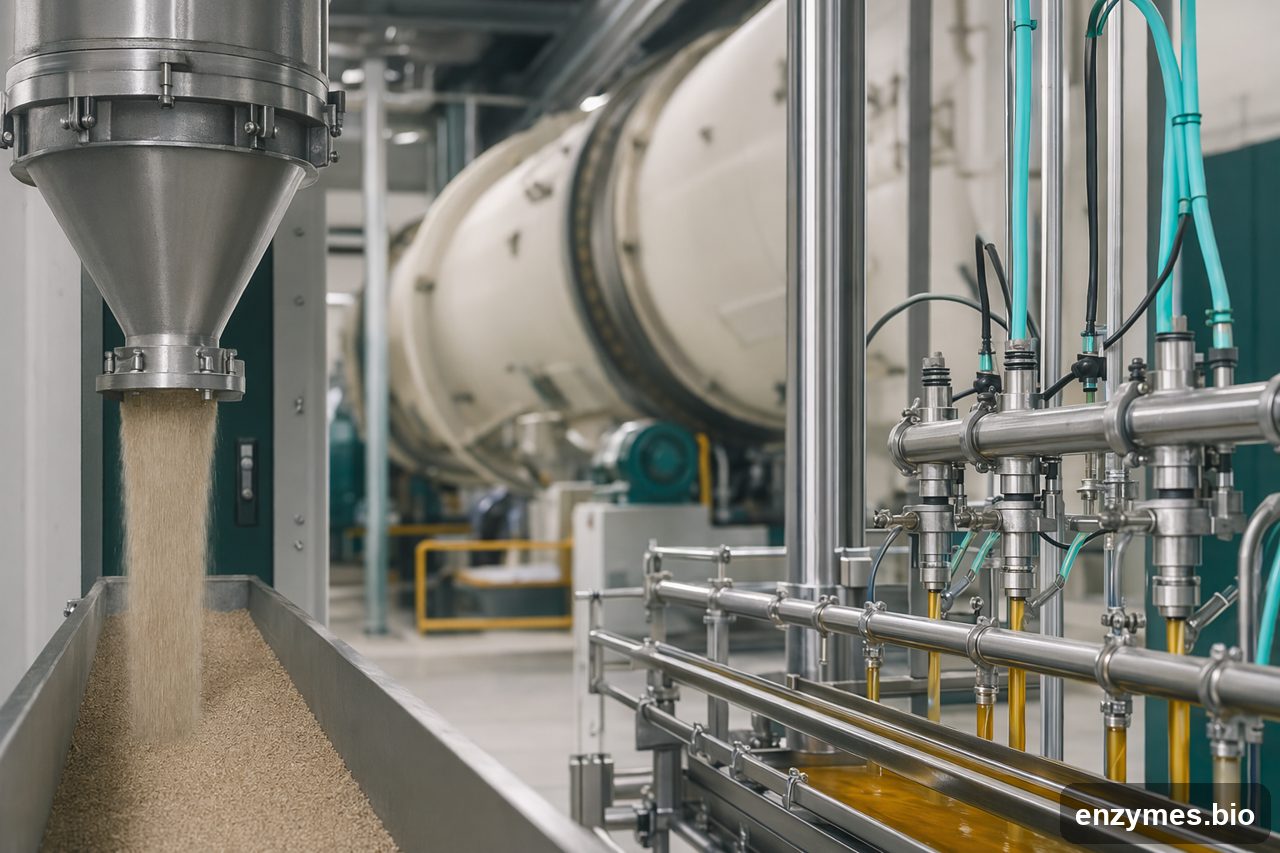
Email us a dosing request with your ingredient matrix (soybean meal and palm kernel percentages), pellet or mash with the conditioner temperature, and species and stage; we send back a trial plan, a mixing order that keeps the enzyme away from the acidifier, the spec sheet questions to put to the supplier, and a sample if you want to run the trial yourself.

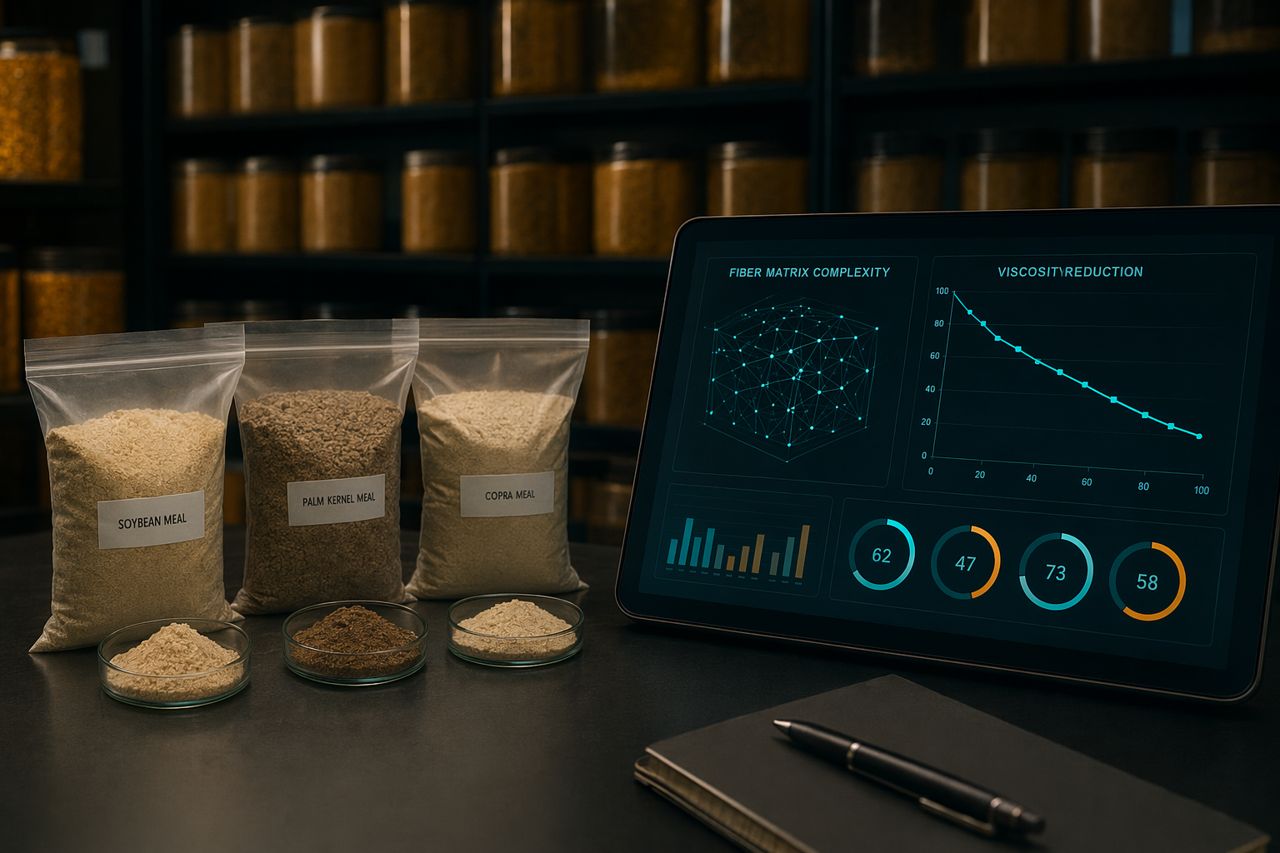
Precision mannan breakdown for smoother industrial flow.
Tell us your application and volume — we reply with pricing and lead time.
We have received your message. We will reply by email.